


RESEARCH
The Academic Significance of the Tōma Seita Collection

- RESEARCH
- The Academic Significance of the Tōma Seita Collection
In October 2025, Nichibunken approved the launch of a research project on the Tōma Seita and Ishimoda Shō archives, and work on the project has just begun. The project will digitize the books, letters, photographs, and diaries of Tōma and Ishimoda entrusted to Professor Isomae Jun’ichi of Nichibunken by the bereaved families. The plan is to begin with the digitization of the Tōma collection.
Tōma Seita was born in Hiroshima in 1913. A historian of ancient Japan, in the postwar period he was at one point the darling of the historical community. With Ishimoda Shō, he spearheaded the national historical movement and led debates on the heroic age, such as over Yamato Takeru. When the national historical movement faltered, Tōma removed himself from the central debates in history, and became something of a “forgotten historian.” Kumamoto was where Tōma chose to make a new beginning. Invited to become a professor at Kumamoto University of Commerce (now Kumamoto Gakuen University) in 1971, he was an active researcher despite having already reached the age of sixty. As a central figure in the Kumamoto Modern History Research Society, he dedicated himself to advancing the study of Kumamoto. His expansive perspective on history was now grounded in Kumamoto but reached out beyond Japan to include East Asia. After the failure of his theory of heroic epochs, in Kumamoto he developed the “East Asian Worlds Theory” as a new theory of ethnicity. Tōma’s “East Asian Worlds Theory” offered a continuation of Ishimoda’s work, as the latter had been forced to abandon his research due to illness.
The Tōma archive is currently managed by Arai Tomoko of the Tōma family and Yamashita Toshifumi, a disciple of Tōma. It is housed at the Tōma Seita “Kibō no Rekishigaku” Museum in Kōshi City, Kumamoto. This museum is Tōma’s old house renovated, and offers the rare example of the archives of a famous historian being preserved in their entirety.
Digitization of the Tōma collection will help to clarify two things: how Tōma’s Marxist historiography was shaped by the political and social conditions of wartime and postwar Japan, and how he perceived East Asia during the Cold War. By digitizing and analyzing the letters Tōma sent to leading postwar historians, we can also show how the likes of Ishimoda Shō, Amino Yoshihiko, and Yasumaru Yoshio developed their historical research through exchanges with Tōma Seita. We look forward to the results of the project.
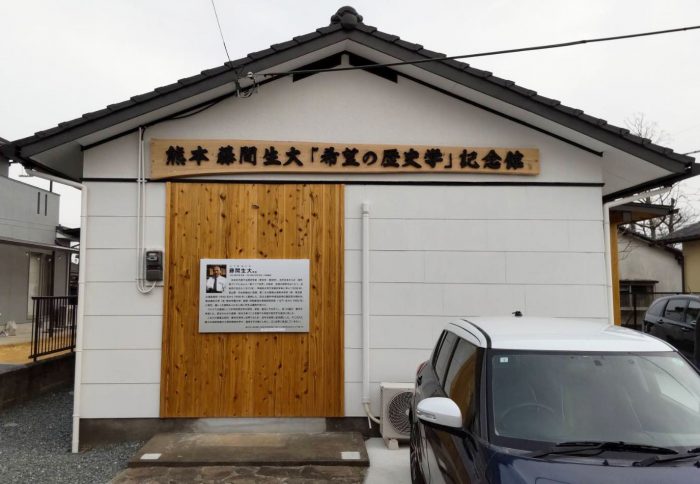
Tōma Seita “Kibō no Rekishigaku” Museum (Photo by the author).
MORE RESEARCH
-
“Japanese” Style
TAKII Kazuhiro(Professor)November 15, 2023 -

As seen from the Periphery and from Below: What I Have Learned from the Japanese Popular Culture Research Project
LIU Jianhui (Professor)June 15, 2023 -
“Japan" as Portrayed in Western Music
MITSUHIRA Yūki (Liberal arts communicator, Center for Information and Public Relations (CIP), National Institu...November 15, 2022 -
From France to Shanghai and Nagasaki: Tracking the Culture Nurtured by the Missionaries
SHIRAISHI Eri (Assistant Professor)September 15, 2022