


COMMUNICATIONS
Our Desired Modernity is so Near and yet so Far

- COMMUNICATIONS
- Our Desired Modernity is so Near and yet so Far
Ever since I first came to Japan from Egypt twenty five years ago, I have been drawn to the peculiar charm of Japanese society. However, the success of Japan’s modernity and the co-existence of utility and rationality within it remains a mystery. While researching the rationalism of Fukuzawa Yukichi and others at Osaka University, I came to realize that here lay the heart of the matter.
However, when I headed home to enthusiastically present my findings to Arab colleagues, I experienced the same kind of shock Fukuzawa felt when he discovered that nobody in Yokohama understood him when he spoke Dutch. Arab academics dismissed a decade of research, merely insisting that, “Japan is an Oriental country. Fukuzawa’s Western-obsessed rationalism does not represent Japan’s true essence.”
In 2017, I spent a year in the exceptional environment of Nichibunken, where I deepened my understanding of figures like Minobe Tatsukichi, Inoue Enryō and Shibusawa Eiichi. Upon returning to Egypt, I again presented my results to Arab colleagues. This time, in stark contrast to my previous experience, I received overwhelming praise.
It was like magic. Those academics who had frowned on Fukuzawa’s rationalism were impressed by Minobe Tatsukichi’s emperor-organ theory and applauded Inoue Enryō’s theory of public religion. For those searching for something distinctly “oriental,” the traditional tinge to Minobe’s legal order or Enryō’s Buddhist-based modernity was crucial. They also heaped praise on Shibusawa Eiichi’s The Analects and the Abacus as, “Precisely the modernity we aspire to.”
The experience taught me that culture is always a mirror, reflecting the image people wish to see. And led me to truly understand the meaning of the phrase “so near and yet so far” for those like me who seek to understand the theory of modernization.
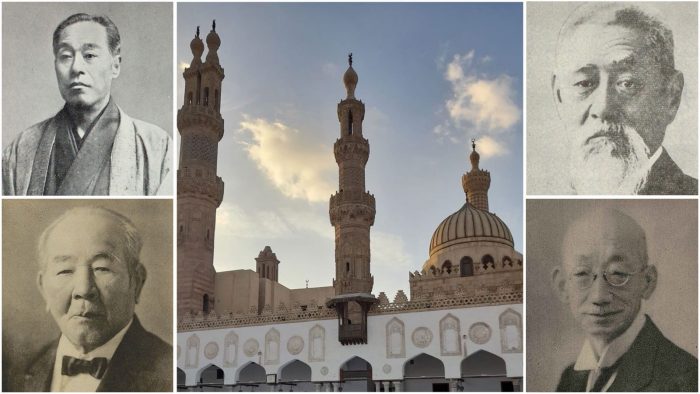
Minarets overlooking Modern Japan: Fukuzawa, Shibusawa, Enryō, Minobe.
Top left: Fukuzawa Yukichi; Bottom left: Shibusawa Eiichi; Top right: Inoue Enryō (from National Diet Library. Kindai Nihon no shōzō (https://www.ndl.go.jp/portrait/))
Center: Al-Azhar University mosque (Photo by author)
Bottom right: Minobe Tatsukichi (“1943nen no Minobe Tatsukichi.” Wikimedia Commons(https://commons.wikimedia.org/wiki/File:Minobe_Tatsukichi_1943.JPG)).


